

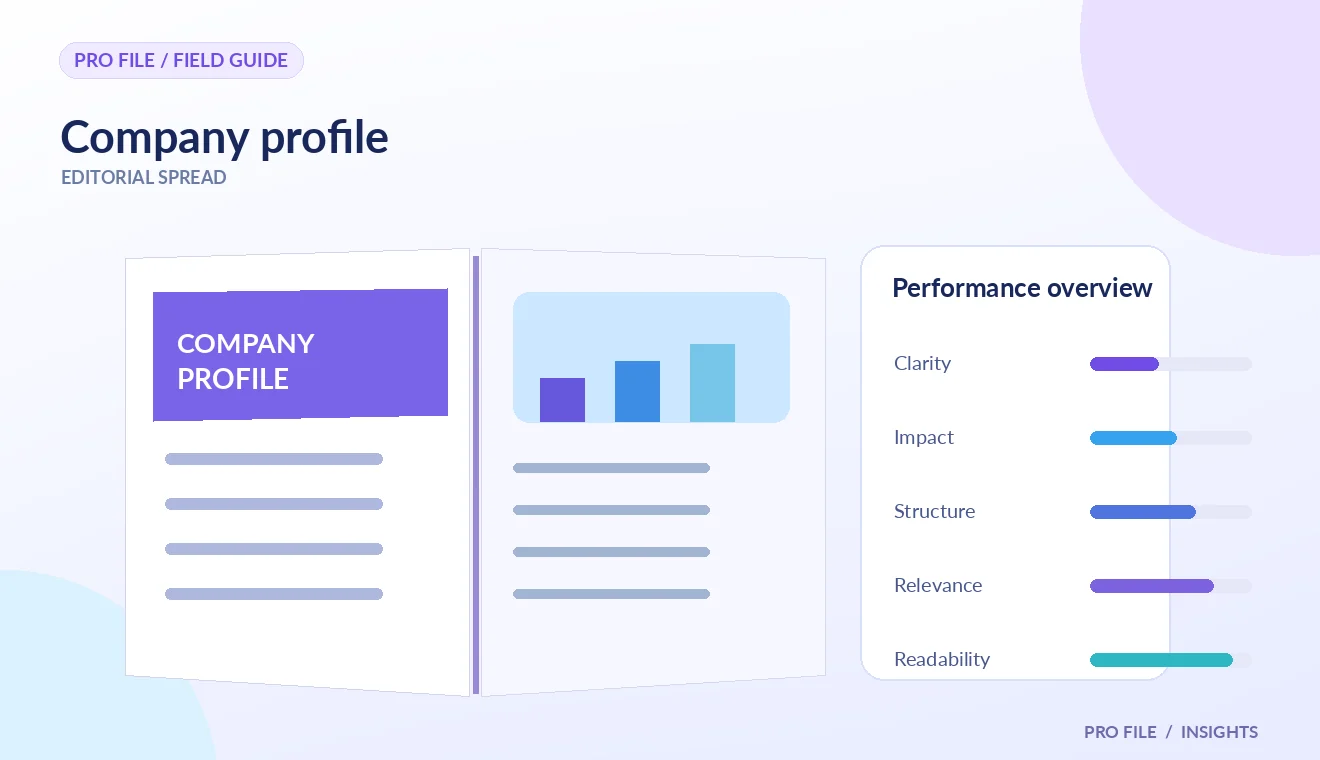
A company profile is a focused way to introduce your business to clients, partners, or other stakeholders. A good profile helps the reader understand who you are, what you offer, and why your company is worth considering.
Quick takeaways
- Define the audience and goal first.
- Use a structure that supports the reader’s decision.
- Prepare content and visuals before design starts.
- Keep the file updated as your business evolves.
Start with audience and objective
Before writing the profile, decide who will read it and what action you want that reader to take.
Different audiences care about different details, so your message and order of information should reflect that.
A short core statement about who you are and what you offer can guide the rest of the document.
Define the use case before writing: will sales email the profile after a call, share it in a meeting, or attach it to a formal proposal? Each situation needs a different level of detail. Once you know the reader’s main question, you can structure the pages to answer it quickly.
- Target audience
- Purpose of the profile
- Main questions the reader may have
- Core message to keep visible
Choose the right sections
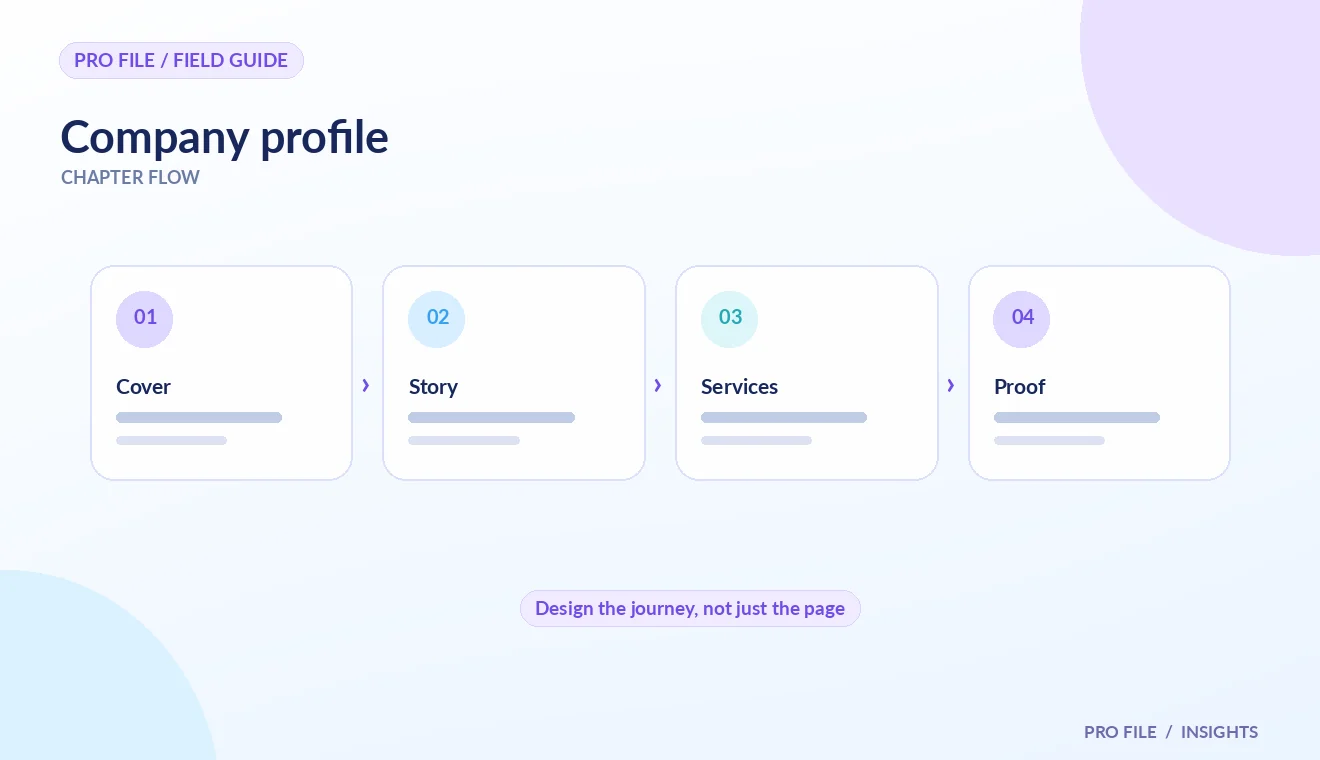
Many profiles work well with a cover, company overview, services, selected work or experience, trust-building details, and contact information.
The goal is not to include every possible section, but to include the right sections for your audience.
The reading flow should move naturally from introduction to value to proof to next step.
Tell a coherent story: a concise introduction, the needs you address, your services or solutions, evidence of capability, and a clear contact option. For businesses with several divisions, present an overview and then group the offerings logically. Avoid repeating the same generic statements on every page.
- Cover and identity
- Who we are
- Services or solutions
- Selected work and proof
- Contact details
Gather material before design
The design process becomes much stronger when the content is already prepared. Gather the logo, service descriptions, approved images, and updated contact data early.
This makes it easier to spot missing material and reduces design revisions later.
If some information is missing, it is better to solve that honestly than to fill the profile with weak placeholder content.
Gather copy, logos, images, project details, and permissions before layout work begins. Assign responsibility for validating names, figures, and claims. Missing source material often leads to crowded pages, generic replacement images, or last-minute changes that weaken the entire presentation.
- Logo and brand assets
- Short company description
- Service descriptions
- Relevant imagery
- Updated contact details
Clear content preparation improves both the design process and the final result.
Present services and proof clearly
Do not present services as names only. Explain what each service does, who it helps, and what kind of outcome it supports.
Then support those statements with selected examples, sectors served, client types, or other credible proof.
Visuals should match the service itself, such as a brochure mockup, a website screen, or a real project example.
Credible proof may include a real project image, a clear delivery process, a current certification, or a documented result. Do not use client logos without permission or claim performance figures that nobody can verify. The aim is to build confidence through useful details rather than decorative badges.
- What the service is
- Who it is for
- What value it offers
- What proof supports it
Make the file easy to read and share
Use clear headings, short text blocks, and a layout that remains readable in PDF format.
Think about the real use case: will it be sent by email, opened on mobile, or shown in meetings?
The best company profile is both visually polished and practically usable.
Think about how the PDF will be received. A huge file is inconvenient on mobile, and tiny text loses impact even when the desktop design looks beautiful. Check interactive links, file naming, consistent page sizes, and legibility. Keep an editable master for future updates.
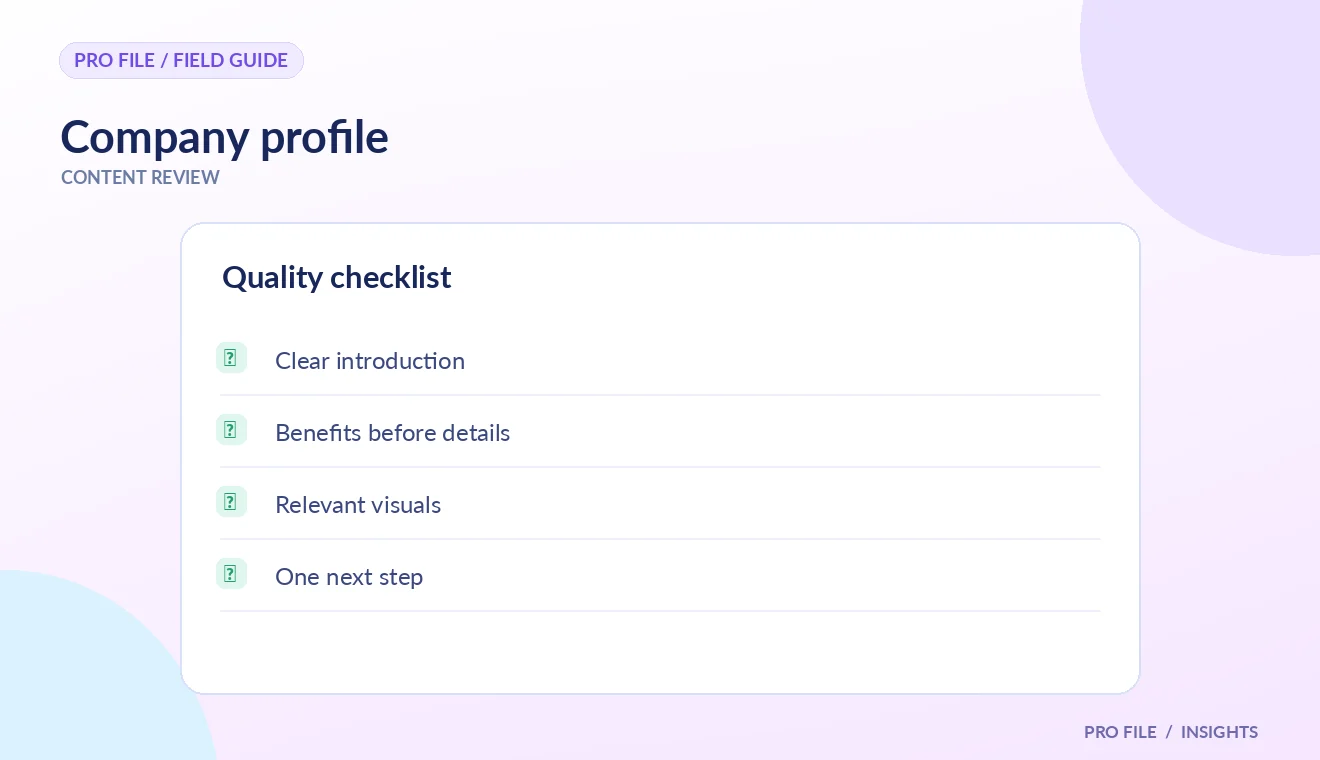
- Clear visual hierarchy
- Short readable copy
- Reasonable PDF size
- Easy-to-use contact details
Treat it as a living business asset
A company profile should evolve as your services, team, sectors, and proof points evolve.
Review it periodically and update sections that no longer represent the business accurately.
When kept current, the profile becomes a practical communication and sales support tool.
Give one team member ownership of the approved profile version, and review it whenever services, people, or contact details change. An internal revision date and one reliable source file prevent outdated copies from circulating. A company profile should remain a useful working asset, not a one-time design exercise.
- Update services and projects
- Refresh contact data
- Review the message regularly
- Keep visuals relevant
A useful profile is maintained, not forgotten after delivery.
Frequently asked questions
How many pages should a company profile have?
There is no single answer. The best length is the one that explains the business clearly without filler.
Can a company profile replace a website?
Not always. A profile is excellent for direct sharing, while a website is stronger for ongoing digital presence and updates.
Should content be prepared before design?
Yes. Content preparation makes the design process much more focused and effective.
Want to put this into practice?
Tell us what you are building and we will help you choose the right presentation format.
Discuss your project
